April is Stress Awareness Month, and the best breathing exercises for stress are not the long ones—they are the tiny ones you actually do. Here are five habits that ride along with routines you already have.
Every April, Stress Awareness Month rolls around and my inbox fills up with ambitious plans. Twenty minutes of breathing every morning. A meditation app. A new journal. I love the intention, and I also know what usually happens by May. The plan was too big for a real life, so it quietly disappeared.
So here is my honest advice as a breath training coach: the breathing exercises for stress that work are the ones that are small enough to survive your schedule. Not a new routine—a tiny addition to a routine you already have. Below are five I use myself and teach most often, each with a one-line how. Pick one. Not five. One.
Why the best breathing exercises for stress are tiny
Stress is not a once-a-day event. It is a low hum that rises and falls all day long, and a nervous system that has been humming for years doesn’t recalibrate in a single long session. What changes it is repetition: many small signals of safety, spread across the day, until the body starts to expect calm instead of bracing against the next thing.
Tiny habits also skip the biggest obstacle, which is starting. When a breath practice is attached to something you already do—the kettle, the sink, the doorway—there is no decision to make. The routine does the remembering for you. That is what makes these breathing exercises for stress stick when the grand plans don’t.
Habit 1: The coffee breath
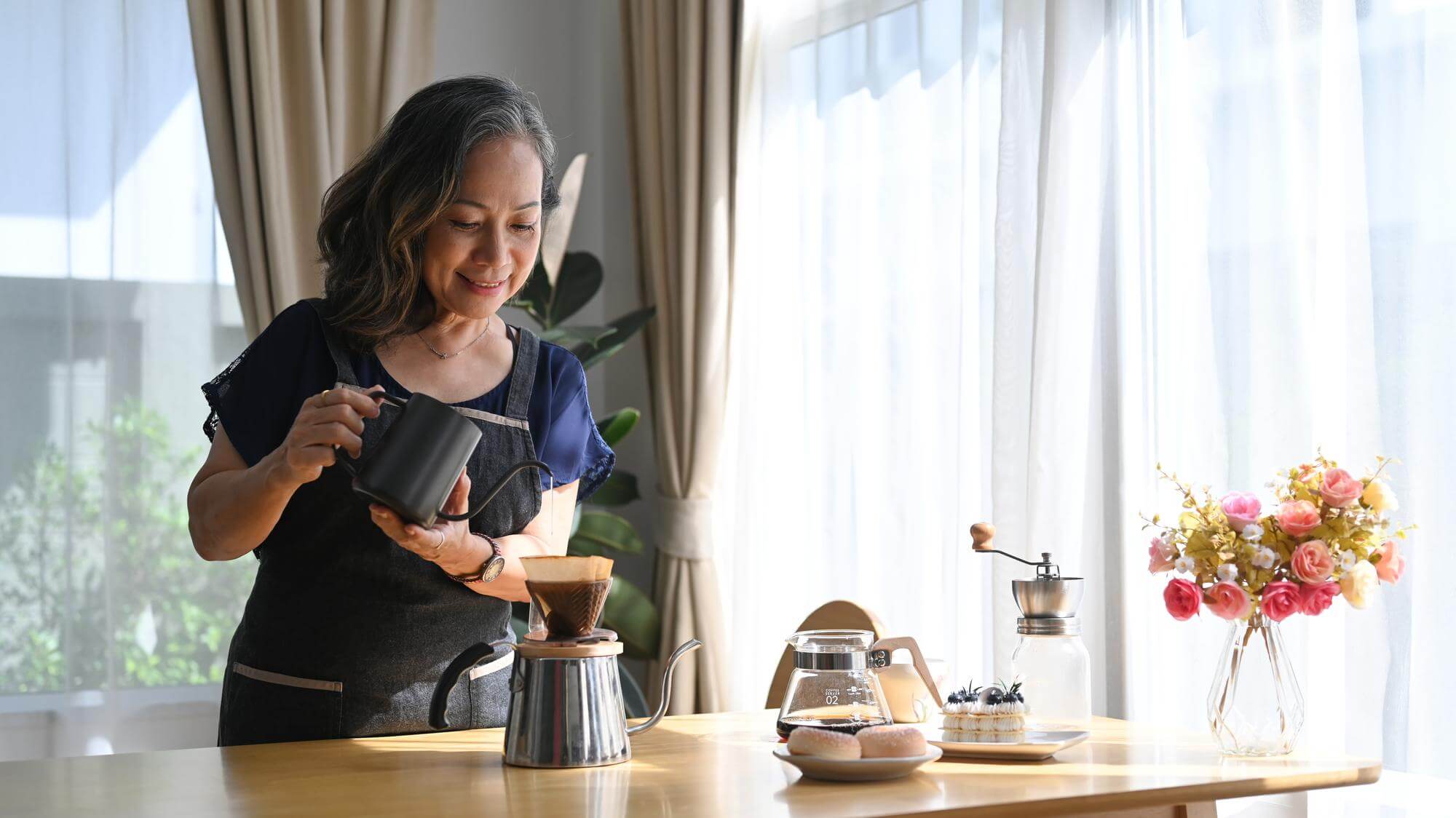
While the coffee brews or the kettle heats, stand still and take three slow breaths through the nose, letting each exhale run longer than the inhale. That is the whole exercise.
Why it works: you are already standing there doing nothing. The long exhale is the simplest signal the body has for “we are not in danger,” and you are sending it before the day has had a chance to get loud.
Habit 2: The hand-washing breath
Every time you wash your hands, close your lips and breathe through your nose for the length of the wash—in slow, out slower. Most of us do this several times a day, which is several free practice sessions.
Why it works: it trains nasal breathing, which paces the breath without you counting anything. And because it happens in the bathroom and the kitchen, it catches you in the middle of the day, right when the shoulders have crept up.
Habit 3: The doorway breath
Before you walk through a door into a new space—the office, the house after work, a meeting room, a waiting room—pause for one breath. Take a normal inhale through the nose, add a short second sip of air on top, and let it all out slowly through the mouth.
Why it works: that double-inhale, long-exhale pattern is the physiological sigh, the fastest reset I know. Doorways are transitions, and transitions are where stress from one place leaks into the next. One breath at the threshold keeps the last room from following you into this one.
Habit 4: The waiting breath
Any time you are stuck waiting—in a line, on hold, at a red light, in the school pickup lane—count your breath instead of checking your phone. In for a count of three, out for a count of six, through the nose, until the wait is over.
Why it works: waiting is one of the most reliable stress triggers of modern life and also one of the few moments with nothing else to do. Turning it into practice flips an irritation into a deposit, and it is one of the few breathing exercises for stress that you can do with your hands on a steering wheel. It is the same three-in, six-out rhythm I teach as a daily practice, just in smaller pieces.
Habit 5: The pillow breath
When your head hits the pillow, put one hand on your belly and take ten slow breaths, exhale longer than inhale, feeling the hand rise and fall. If you fall asleep before ten, that counts.
Why it works: the last thing you hand your nervous system before sleep sets the tone for the night. A long exhale at bedtime is the gentlest wind-down lever we have, and the pillow is a cue you will never forget to encounter.
How to make breathing exercises for stress actually stick
- Anchor it. Attach the breath to something you already do every day. The anchor, not willpower, is what keeps it alive.
- Keep it embarrassingly small. Three breaths. One breath. If it feels too easy, you have sized it right.
- Don’t keep score. Streaks are another thing to be stressed about. A missed day is not a broken habit; it is a day.
- Notice, don’t force. You are not trying to feel calm on command. You are practicing a signal. The feeling follows with repetition.
- Add the second one later. Once the first habit runs on its own, pick another. One at a time is how they last.
If the idea of managing stress itself feels like one more task, I wrote about that frustration in managing myself in the mess. The short version: you don’t have to fix your life to breathe differently in it.
Stress Awareness Month is a nudge, not a deadline
You don’t need a perfect month of practice, and you don’t need the longest breathing exercises for stress you can find. You need one tiny habit that is still with you in June, and another that joins it in the fall. That is how a breath practice grows—quietly, attached to ordinary moments, until one day you notice your shoulders are down and you can’t remember when that happened. If you want the longer, guided versions of these rhythms, they are waiting on our practices page whenever you are ready.
If you want help choosing the one habit that fits your real life—and building from there—book a free consultation and we will figure it out together.