If you learn one rhythm from me, let it be flow breathing: inhale for three, exhale for six, no hold. Here is why that ratio settles the body, how to follow along, and where to find the guided videos.
People often expect breath training to start with something elaborate — a long hold, a complicated count, a special posture. It does not. The first thing I teach nearly everyone is the same gentle rhythm, and most of what comes later is built on top of it. I call it flow breathing, and the shorthand is 3-0-6-0: breathe in for three, hold for zero, breathe out for six, hold for zero.
Those zeros matter as much as the three and the six. Flow breathing is meant to move like a tide — in, out, in, out, with no pauses at the top or bottom. This post explains why I teach it first, why the ratio is what it is, how to follow along, and where to find the guided videos so you do not have to count on your own.
What flow breathing is
Flow breathing is slow, nasal, continuous breathing with an exhale that is twice as long as the inhale. A full cycle takes about nine seconds, which lands you a little under seven breaths a minute — well below the quick, shallow pace most of us default to during a busy day. The inhale is small and quiet and fills low, toward the belly. The exhale is soft and unhurried, like fogging a mirror with your mouth closed.
The two zeros mean there is no deliberate hold anywhere, at the top or the bottom. You do not pause with full lungs and you do not squeeze to empty. The moment the inhale is done, the exhale begins; the moment the exhale is done, the next inhale begins. Smooth turnarounds are the whole skill.
Why three in, six out
The ratio is not arbitrary. Each breath nudges the nervous system in two directions: the inhale leans slightly toward alert, and the exhale leans toward settle — the heart speeds a touch on the way in and slows on the way out. When the exhale is twice as long as the inhale, you spend most of every breath on the settling side. Over a few minutes, that adds up, and the body starts to read it as a signal that nothing is chasing you.
Why not make the exhale even longer? You could, eventually. But three and six are easy to hold in your head, comfortable for most lungs, and slow enough to do the job without strain. If you push the count before your body is ready, the breath gets tight, and tightness is exactly what we are trying to undo. Flow breathing is meant to feel like an easy downhill walk, not a workout.
Why no hold
Breath holds are useful tools, and I do teach them later. But as a first practice they create two problems. For a body that is already a bit keyed up, a hold often reads as “something is wrong with my air,” which can bring on exactly the alarm we are trying to quiet. And holds tend to invite effort — people brace, clench, and count too hard — which pulls attention away from the thing that matters most: letting the breath move low and slow.
Taking the hold out keeps the practice gentle and keeps you honest. If you cannot do 3-0-6-0 comfortably, there is nothing to push through — you simply shorten the exhale (three in, four or five out) and grow from there. Flow is the goal; the numbers are just the scaffolding.
A follow-along structure
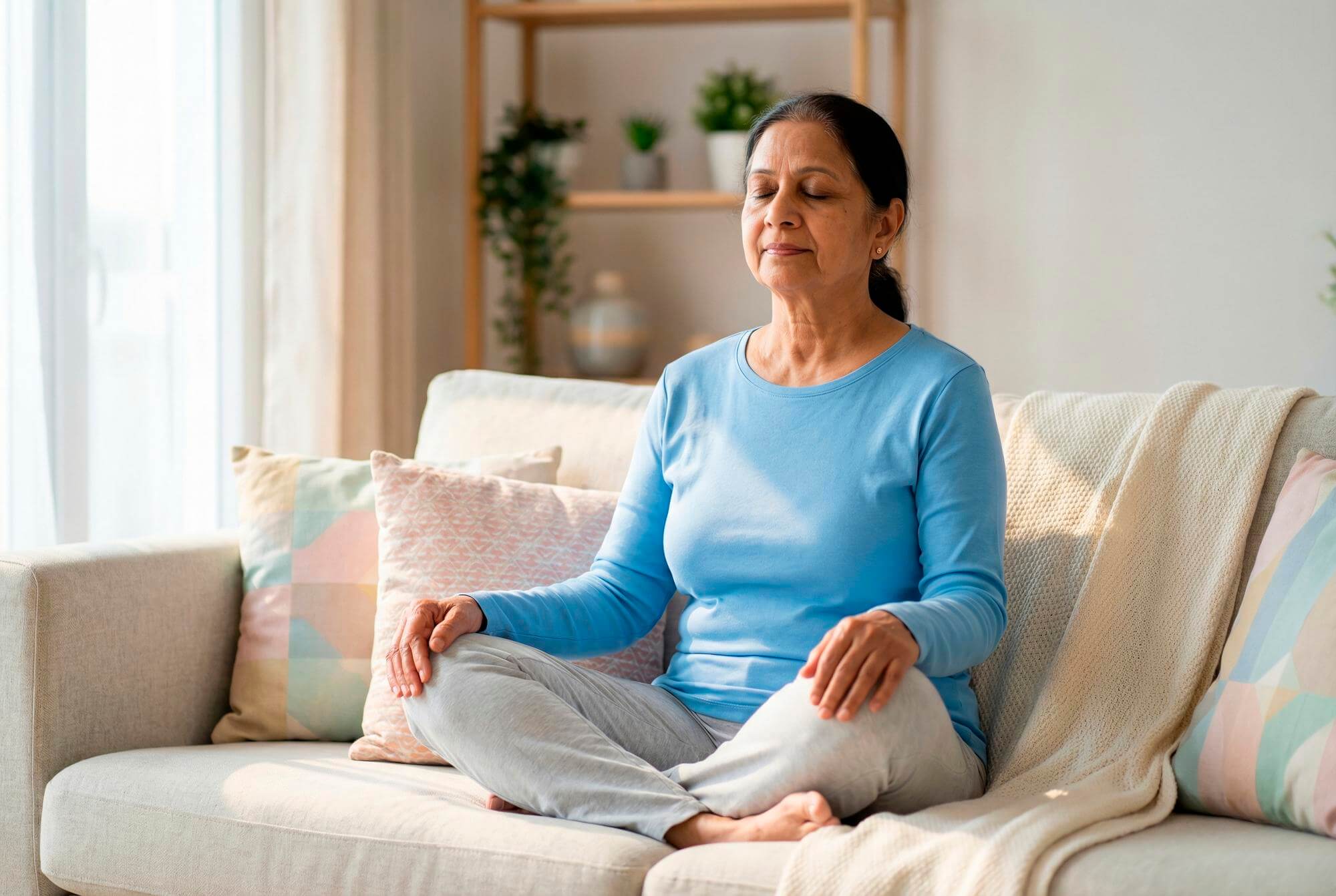
Here is the shape I use in the guided practices. You can do it seated or lying down, eyes closed or softly open. Ten minutes is lovely; three is still worth doing.
- Settle (about a minute). Sit or lie comfortably, mouth closed, one hand on your belly. Do not change anything yet. Just notice where the breath is going and how fast it is moving.
- Lower it (a minute or two). Let the inhale arrive low, so the hand on your belly rises first. Keep it small and quiet. Let the exhale be soft and a little longer than the inhale — no counting yet.
- Find the rhythm (the main part). Begin the count: in for three, out for six, through the nose, no pauses. Let the turnarounds be smooth. If your mind wanders, come back to the count without any fuss; wandering and returning is the practice.
- Let go of the numbers (the last minute). Drop the count but keep the shape — low, slow, longer out. Let the breath become whatever it wants to be now. Sit for a few breaths and notice what has changed.
Right now, wherever you are: close your mouth, breathe in through your nose for a count of three, and let the breath out for a count of six. No hold. Do it five times. That is less than a minute, and it is a real round of flow breathing.
Common hiccups
- Running out of air on the exhale. You are probably pushing it out. Let it leak rather than squeeze; if six still feels too long, use five and build up.
- The inhale gets greedy. After a long exhale there is a temptation to gulp the next breath. Keep the inhale small and unhurried — you need less air than you think.
- Feeling light-headed. Ease off. Shorten the count, breathe a little more normally for a moment, and come back gently. Flow breathing should feel comfortable, and if it does not, that is information, not failure.
- Boredom. Honestly, that is a good sign. A bored mind is a mind that has stopped scanning for threats. Stay with it.
Where to practice along
Counting on your own is fine, but most people find it easier to follow a voice — especially at the beginning, when the mind is busy and the rhythm is new. I recorded two short videos for exactly that reason: Flow Breathing 3-0-6-0, a guided round you can do any time, and Principles of Flow Breathing, which walks through the why in a little more depth. Both live on the practices page, free to use as often as you like.
If you are new to all of this, it may help to know that flow breathing is not the same as “taking deep breaths,” and it is not a hack — I wrote about that distinction in breathwork isn’t just deep breathing. Flow breathing also makes a gentle doorway into stillness for people who find meditation hard to start, because it gives the mind one simple job.
Three in, six out, nothing in between. It is the simplest thing I teach and, for most people, the one that changes the most.
Try the guided round on the practices page, and if you would like help making flow breathing a daily habit, book a free consultation.